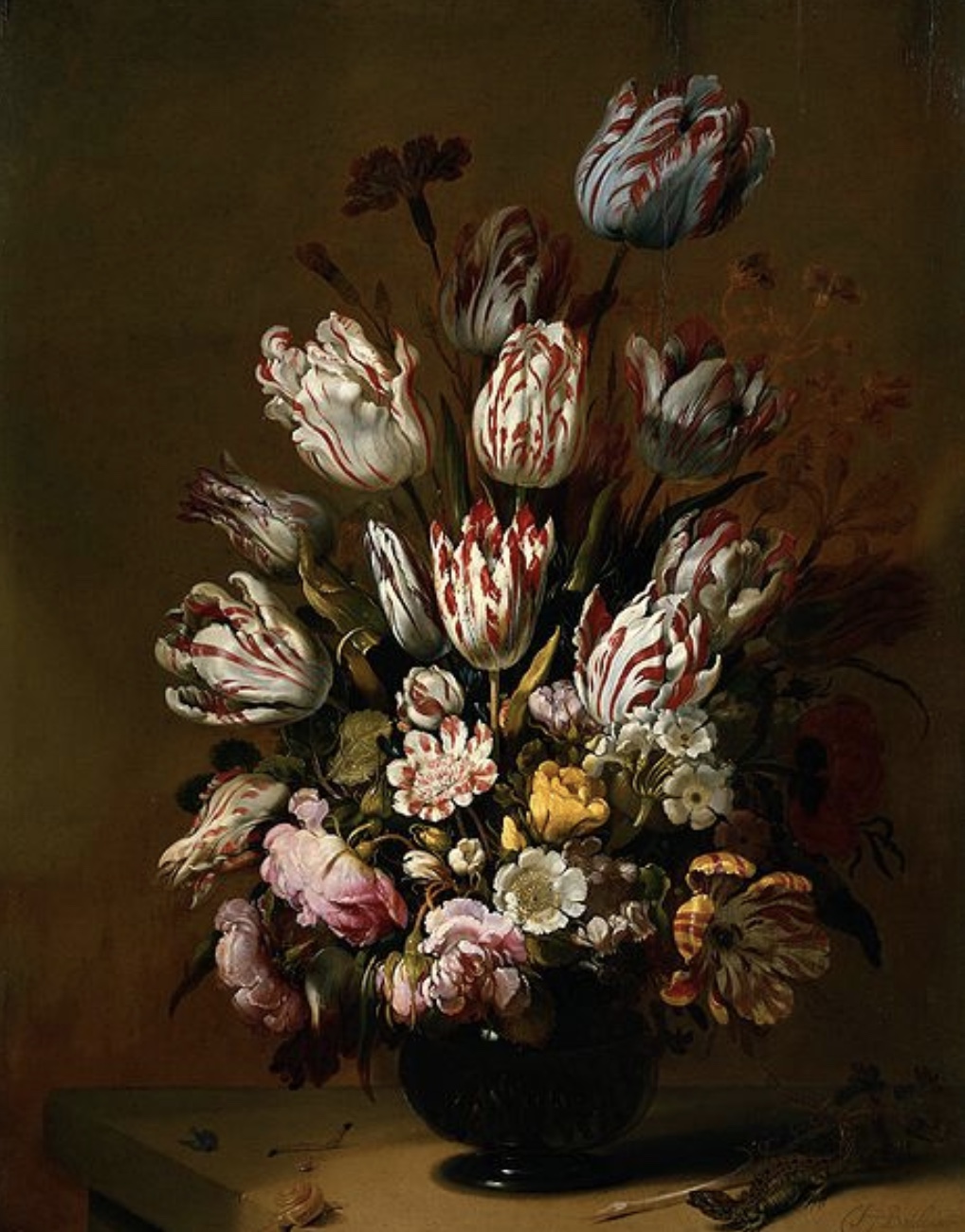
Before the dot-com bubble or the housing crisis, there were flowers.
Specifically tulips, which were very popular in the Netherlands in the 1600s. So popular, in fact, that they created a huge economic bubble that eventually crashed, leaving many people bankrupt and out of luck. This is generally considered to be the first asset bubble in economic history.
Some tulip bulbs were selling for ten times the average skilled worker’s annual salary. Let’s take a trip back in time to an era when pretty flowers almsot crashed a national economy.
1
Tulips were first introduced to Europe in the 16th century, possibly from the Ottoman Empire. They became popular in the Netherlands after a botanist realized that tulips were able to tolerate the harsh conditions better than other flowers.
2
Holland was in its golden age, with huge trade fortunes allowing for money to be spent on luxuries. Tulips, which were more colorful and saturated than other flowers in Europe at the time, became a coveted luxury good in the early 1600s.
3
Tulips were classified into different groups based on their color; single-colored, multicolored, violet, and the most coveted variety: the ‘Bizarden’ or ‘Bizarres’, which featured yellow or white streaks on a red, brown, or purple background.
4
As tulip growers bred new varieties, they gave their creations extravagant names like ‘Admiral’, ‘General’, or even ‘Admiral of Admirals’. New varieties were being created constantly with wildly variable names, and most of these types of tulips no longer exist today.
5
The tulips only bloomed for about a week in April and May, remaining dormant from June to September. While dormant, the plants’ bulbs could be uprooted and moved around, so this was when most tulip purchases took place.
6
Florists, or tulip traders, began to sign forward contracts to buy tulips at the end of the season. This created a market for tulip bulbs, which were considered goods that yielded utility over time.
7
Tulips grew in popularity and growers demanded higher and higher prices for their special varieties. By 1634, speculators had entered the market. Prices continued to rise, both for rare varieties, and eventually for more common types as well. It seemed like the price would continue to rise forever, and the passion for tulips would never end.
8
Tulip mania reached its peak during the winter of 1636-37. In 1937, a tulip known as “The Viceroy” was offered for sale for between 3,000-4,200 guilders. A skilled artisan’s annual salary at the time was about 300 guilders.
9
During tulip mania’s peak, some contracts were changing hands five times. Then, in February 1637, tulip bulb contract prices suddenly collapsed, and the trade of tulips halted. The exact circumstances of the crash are unknown.
10
People had taken out loans to buy tulip bulbs, hoping to sell the bulbs for a profit as the market continued to grow and use the money to repay their debts. But when the tulip bubble popped and prices plummeted, bulb holders were forced to sell low and many had to declare bankruptcy.
11
The crash of the tulip market didn’t affect Holland’s economy too badly, but it did undermine social expectations, as well as harming relationships based on trust and contracts. People who had promised to pay for a good at the end of the season were no longer able to. The Dutch court system was busy with tulip-based disputes all the way into 1639.
12
Tulip mania is generally considered to be the first example of an asset bubble in history. These bizarre events and obsessions ended up making economic history. Today, economists still use the term ‘tulip mania’ to refer to large economic bubbles. Though we may have moved on from losing our minds over flowers, speculative bubbles still occur today.